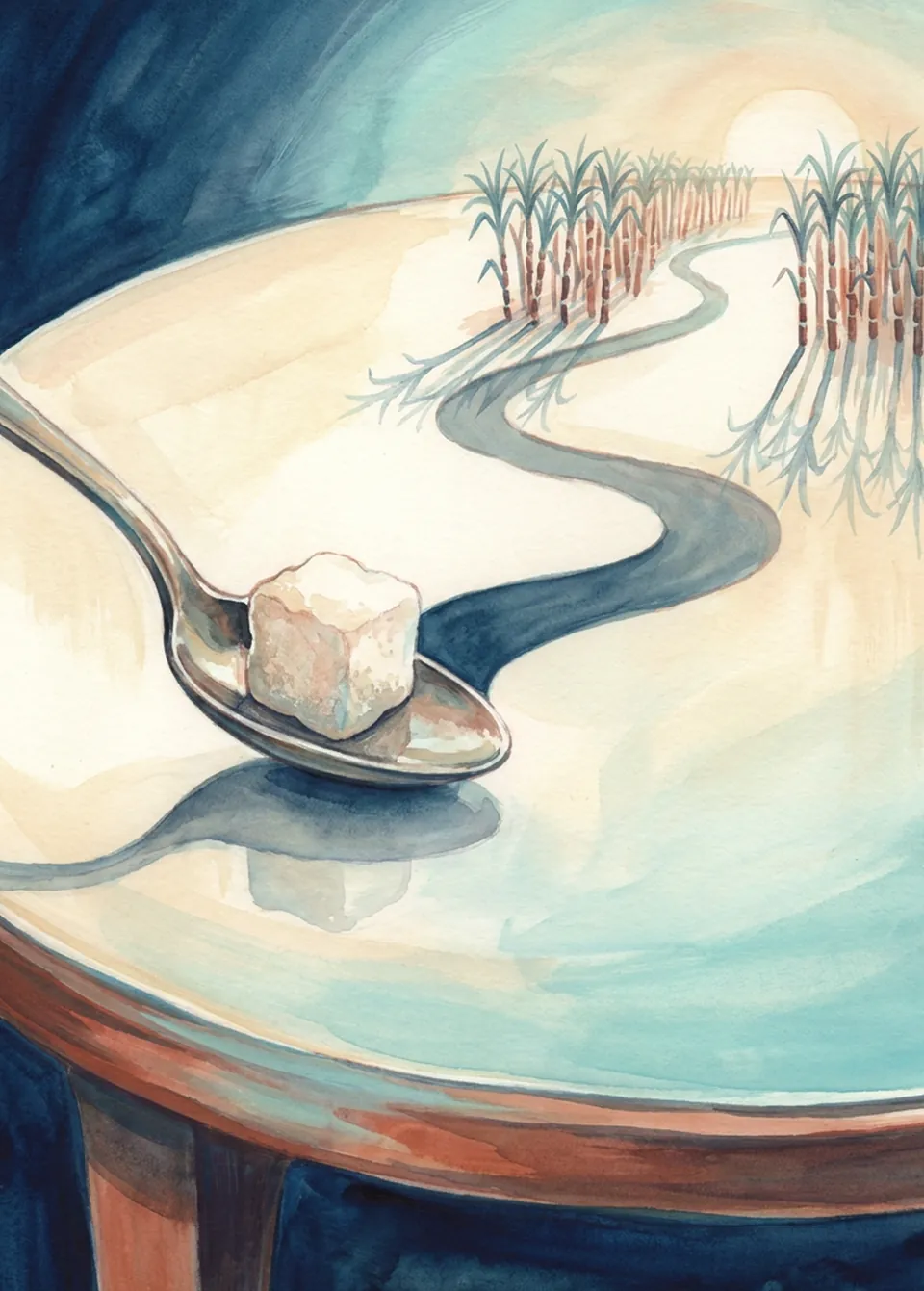
Only the Yield
The plantation stayed overseas; only its yield arrived.
Why this image
A single sugar cube lies on a silver spoon on a polished table, and across the tabletop a dark winding line leads back to rows of sugar cane under a low sun. There were no plantations in Leiden; they lay overseas, and what came to Leiden was their yield, the goods and the money 1. While Johan van der Maersche was mayor of Leiden, enslaved people on his plantation Crawassibo in Suriname produced sugar for his profit, and until his death in 1743 a shipload arrived every year 2. Plantation owners lived on the Rapenburg, some with African servants brought back as staff 3. Not painted, but the same: sugar went to Japan through Deshima 4.
What it draws on · 4
de plantages lagen overzee
There were no plantations in Leiden or its region: they lay overseas. Crawassibo was in Suriname; the Leiden cloth merchant Daniel van Eijs (1688-1739) was closely tied to four plantations in Berbice, a Dutch colony on the north coast of South America. What came to Leiden was not the plantation but its yield: the goods and the money.
Sources · 3
- Leiden In Motion: De Diversity Walk — Stichting Güney / Turksarchief.nl
- Museum De Lakenhal — 'Onderzoek toont relatie tussen Leidse lakenhandelaar en slavernijverleden' (Daniel van Eijs, Berbice)
- Sleutelstad — 'Duistere kant Leids verleden' (4 april 2025)
de burgemeester en zijn plantage
Johan van der Maersche managed the sugar plantation Crawassibo in Suriname for decades. In 1719 he returned to Leiden and was taken straight into the city government; he remained the plantation's owner. While he was burgemeester — mayor — of Leiden, enslaved people in Suriname produced sugar for his profit, and until his death in 1743 a shipload of sugar arrived every year. In 1697 he had complained to the WIC that of the twenty people he had 'ordered', only ten were delivered.
Sources · 2
- Sleutelstad — 'Duistere kant Leids verleden: stadsbestuur en universiteit nauw verweven met koloniaal en slavernijverleden' (4 april 2025)
- Vooronderzoek Koloniale en slavernijgeschiedenis van de stad Leiden — Giay, Sow & Ramackers (2025)
de gracht van de rijken
The Rapenburg was the grandest canal in Leiden: regents — the patrician families who governed the city — lived here, along with professors and wealthy merchants. In the seventeenth and eighteenth centuries plantation owners lived here too, and some brought their African servants back to Leiden with them. Those people were not here as free residents of a mansion, but as staff.
Sources · 3
- Leiden In Motion: De Diversity Walk — Stichting Güney / Turksarchief.nl
- Universiteit Leiden — 'Keti Koti in Leiden: here, too, slavery is all around us' (2022)
- Gert Oostindie & Karwan Fatah-Black, 'Sporen van de slavernij in Leiden' (Leiden University Press, 2017)
Deshima
From 1641 to 1854 the Dutch held a trading post on Deshima, an artificial island in the bay of Nagasaki. For two centuries they were the only Western nation permitted to trade with Japan, and so Japan's window on the outside world. Chinese silk, cotton, sugar, medicines, deer hides, books and scientific instruments went in; copper, silver, camphor, porcelain, lacquerware and rice came back.
Sources · 2
- Wereldmuseum Leiden — 'Deshima, the Dutch trading post in Nagasaki'
- National Diet Library Japan — 'Japan-Netherlands Exchange in the Edo Period: Dutch Factory on Deshima'
Shares its places with · 7
 Named After a CoastMansions along the canals (Slavery/Colonialism) · Mansions on the Rapenburg
 The Same RouteMansions along the canals (Slavery/Colonialism) · Japan Museum SieboldHuis
 Cloth That BoughtMansions along the canals (Slavery/Colonialism) · Mansions on the Rapenburg
 Carried HomeJapan Museum SieboldHuis · Mansions on the Rapenburg
 In the SteamMansions along the canals (Slavery/Colonialism)
 The Only WindowJapan Museum SieboldHuis
 The SilenceMansions on the Rapenburg
Painted with an image model from the facts on this page, and chosen by hand. City in Motion.