Stars in Arabic
Europe's sky was first read through Arabic books.
Why this image
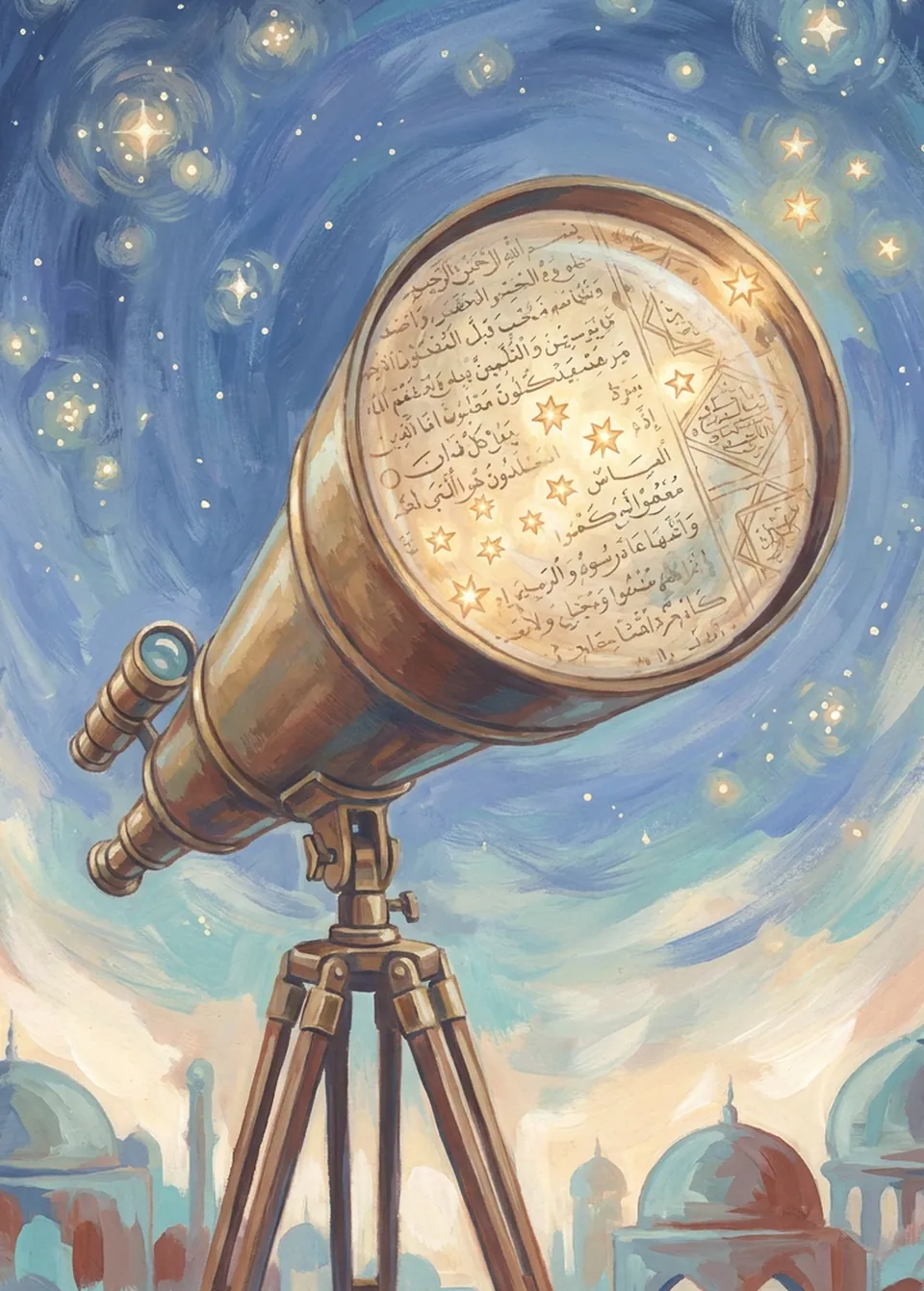
A brass telescope on a tripod points at a starry evening sky over domes and arches, but its lens is a round page of Arabic script, and the stars shine through the writing. In 1629 Golius was given a chair in mathematics and astronomy, and in 1669 his edition of al-Farghani's Arabic astronomical handbook appeared, with his own Latin translation 1. The observatory he asked for goes back to 1633, the oldest university observatory in the world, and it began with an instrument, not a building 2. Scaliger, too, read Arabic works of astronomy and mathematics in Arabic, not in translation 3.
What it draws on · 3
de sterrenwacht en al-Farghani
In 1629 Golius was given a second chair at Leiden, in mathematics and astronomy, and he founded the first Leiden observatory. Even so, his name does not rest on discoveries of his own in the sky: two years after his death, in 1669, his edition of the Arabic text of al-Farghani's astronomical handbook appeared, with his own Latin translation and extensive notes. What he contributed to astronomy was making Arabic science available to Europe.
Sources · 3
- Leiden In Motion: De Diversity Walk — Stichting Güney / Turksarchief.nl
- MacTutor History of Mathematics — Jacob Gool (1596-1667)
- Jacobus Golius, uitgave van al-Farghani's astronomisch handboek (1669), Arabische tekst met Latijnse vertaling
de oudste universiteitssterrenwacht
Leiden's observatory goes back to 1633, which makes it the oldest university observatory in the world. It came out of a request by Jacobus Golius, who wanted somewhere to use a large quadrant made by Rudolph Snellius. It began not with a building but with an instrument.
Sources · 2
- Leiden Observatory — Engelstalige Wikipedia: oudste universiteitssterrenwacht ter wereld, 1633, Golius en de kwadrant van Snellius
- Universiteit Leiden — Old Observatory / Sterrewacht: geschiedenis
de talen en de Koran
By the university's own count Scaliger commanded some thirteen languages, among them Arabic, Hebrew, Persian and Turkish. He learned Arabic on Guillaume Postel's advice, after Greek and Hebrew. And he went to the sources themselves: he read the Qur'an and Arabic works of astronomy and mathematics, not translations of them.
Sources · 3
- Leiden In Motion: De Diversity Walk — Stichting Güney / Turksarchief.nl
- Universiteit Leiden — 'Josephus Scaliger: groot geleerde en brompot' (2020)
- Encyclopaedia Britannica / Wikipedia — Joseph Justus Scaliger: Arabisch geleerd op aanraden van Guillaume Postel
Shares its places with · 5
 The BequestMemorial Stone for Scaliger · The House of Jacob Golius
 East Through BooksMemorial Stone for Scaliger · The House of Jacob Golius
 Half SailedMemorial Stone for Scaliger
 The Sky TurnsObservatory
 Carried HomeThe House of Jacob Golius
Painted with an image model from the facts on this page, and chosen by hand. City in Motion.