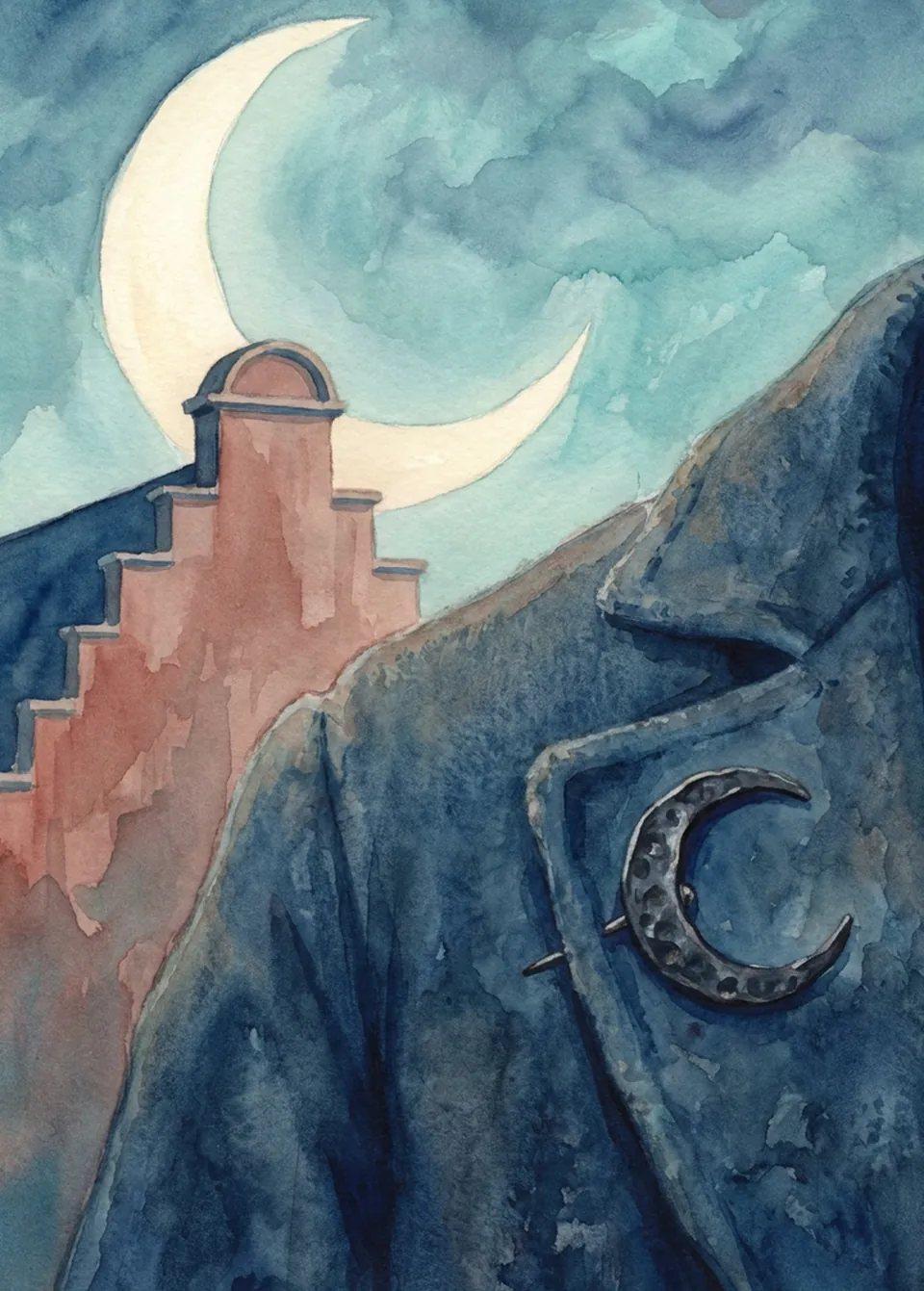
The Moon
A sign from another faith, worn by those who wanted to stay what they were.
Why this image
A dark woollen coat fills the foreground, and on its lapel a crescent of hammered iron is pinned like a badge. The Sea Beggars, who freed Leiden from the Spanish in 1574, wore their slogan 'Liever Turcks dan Paaps' on crescent-shaped medals pinned to the sleeve 1. Behind the coat a stepped terracotta gable stands under a large pale crescent, as a cast-iron crescent sits on every small tower of the town hall's facade: the shape of the Turkish flag, used as a sign of resistance 2. Not painted, but part of the same story: at In den Vergulden Turk an Easterner in a turban stands between Neptune and Mercury, trade with the Orient by sea 3.
What it draws on · 3
Liever Turcks dan Paaps
'Liever Turcks dan Paaps' — rather Turkish than papist — was the slogan of the revolt. The Sea Beggars, who freed Leiden from the Spanish in 1574, wore the saying on crescent-shaped geuzenpenningen, the Beggars' medals, pinned to the sleeve as a party badge. The crescents on the town hall are attributed to that same slogan.
Sources · 4
- Leiden In Motion: De Diversity Walk — Stichting Güney / Turksarchief.nl
- Dutch Revolt (Universiteit Leiden) — spreuken: 'Liever Turks dan paaps'
- Rijksmuseum — Geuzenpenning in de vorm van een halve maan
- Mare — 'Langs de Leidse halve maantjes'
de halve maantjes
On every one of the small towers of that facade sits a cast-iron crescent. The shape is that of the Turkish flag, and here it served as a sign of resistance against the Spanish. Leiden's town hall therefore carries an Islamic symbol, put there by a Protestant city at war with a Catholic empire.
Sources · 3
- Historische Vereniging Oud Leiden — 'Halve maantjes op het stadhuis'
- Mare — 'Langs de Leidse halve maantjes'
- Cor Smit — boekje over de historische banden tussen Leiden en Turkije, voor Stichting Güney
de drie figuren
In the pediment stand three figures by the Flemish sculptor Pieter Xavery (1647 — after 1674), from left to right: Neptune, god of the sea; an Easterner in a turban, described as an Ottoman merchant and sometimes identified as Barbaros Hayreddin Pasha; and Mercury, god of commerce. Together they say one sentence: trade with the Orient, by sea. The man in the middle is the trading partner, standing between the sea and the profit.
Sources · 3
- Leiden In Motion: De Diversity Walk — Stichting Güney / Turksarchief.nl
- Rijksmonumenten.nl — beschrijving van het fronton (Pieter Xavery, ca. 1673)
- Pieter Xavery — Vlaams barokbeeldhouwer, werkzaam in de Republiek
Shares its places with · 6
 A Seed in a LetterLeiden City Hall - Crescent Moons
 Remain What You AreLeiden City Hall - Crescent Moons
 The Refilled CityLeiden City Hall - Crescent Moons
 The Name RemainsIn den Vergulden Turk (At the Gilded Turk)
 A Thread from FarIn den Vergulden Turk (At the Gilded Turk)
 Another FlagIn den Vergulden Turk (At the Gilded Turk)
Painted with an image model from the facts on this page, and chosen by hand. City in Motion.