The Name Remains
The name stays after the thing it named has gone.
Why this image
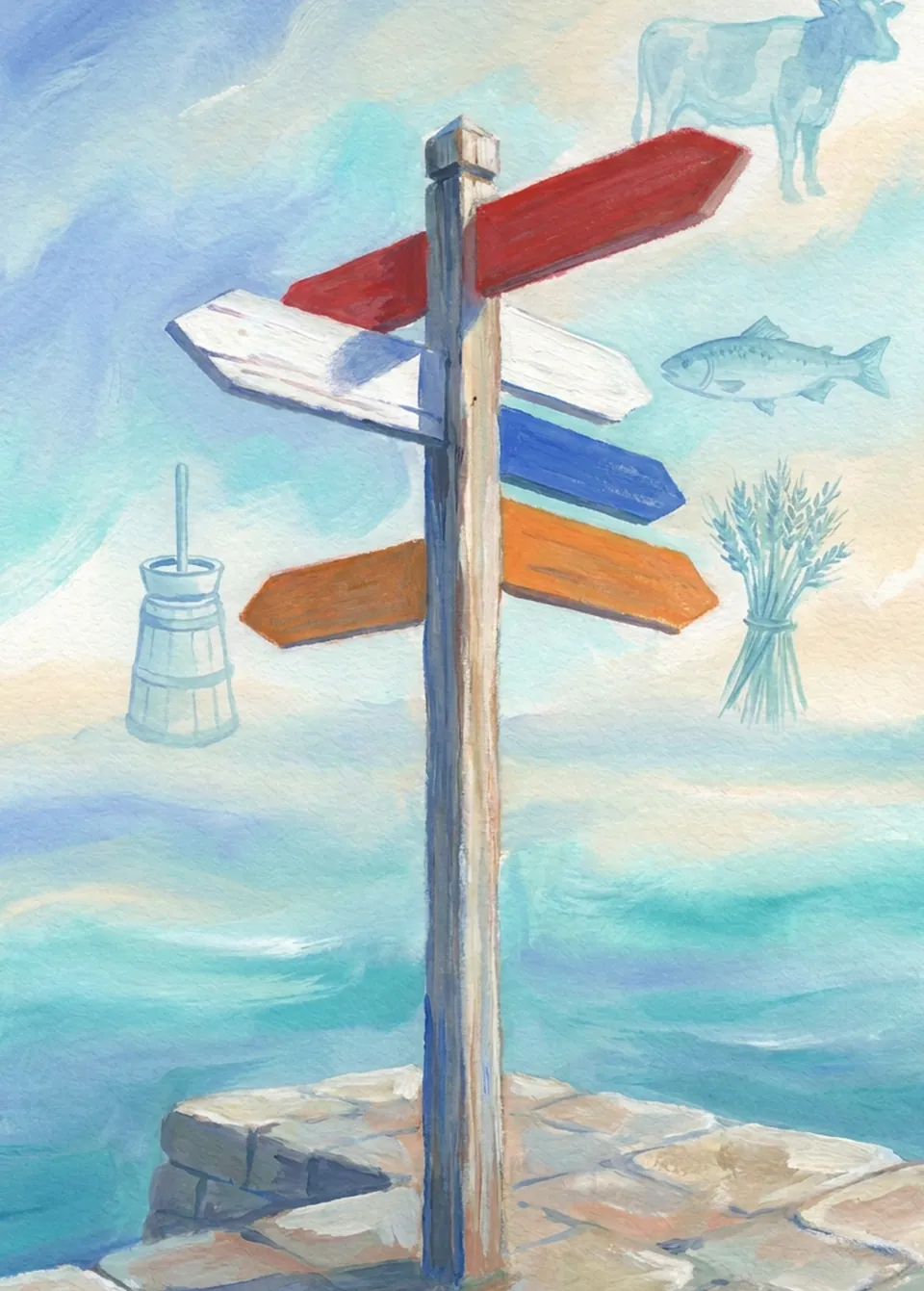
An old signpost stands on a stone quay by the water, its arms painted red, white, blue and orange, each pointing at a faint outline in the air: a cow, a fish, a butter churn, a sheaf of grain. The parts of the market on the Nieuwe Rijn are still named for what once lay there: the Botermarkt for butter, the Vismarkt for fish, the Koornbrug for grain, the Karnemelksbrug for buttermilk 1. The Beestenmarkt is named after the livestock traded on it from 1616 to 1930 4. Not painted, but the same: the Singelpark's names count off the city's trades 2, and of the house's old name, the Vergulde Druyff, only 'gilded' survived into In den Vergulden Turk 3.
What it draws on · 4
de namen van de plekken
The parts of the market are still named for what once lay there: the Botermarkt for the butter farmers from around the city sold there, the Vismarkt for the fish, the Koornbrug for the grain, the Karnemelksbrug for the buttermilk. Beside them lie the Gangetje and the Nieuwe Rijn itself. Every ware once had its own corner.
Sources · 2
- Gemeente Leiden — marktflyer 2025: Gangetje, Karnemelksbrug, Botermarkt, Nieuwe Rijn, Koornbrug
- Nederlandstalige Wikipedia — Botermarkt (Leiden); Nieuwe Rijn; Vismarkt
de namen van de parken
The ring strings existing parks together: the Plantsoen, the Katoenpark, the Ankerpark, the Blekerspark, the Huigpark, the Energiepark, the Lakenpark, the Rembrandtpark and the Sterrenpark. Those names count off the city's trades — laken and katoen from the cloth trade, the anchor from the forge, the bleacher from the whitening of fabric. Walk the loop and you read where Leiden earned its living.
Sources · 2
- Nederlandstalige Wikipedia — Singelpark: Rembrandtpark, Sterrenpark, Blekerspark, Huigpark, Energiepark, Ankerpark, Lakenpark, Katoenpark
- Gemeente Leiden — projecten: Singelpark
de Vergulde Druyff
The house was not always called that. Documents from 1635 and 1671 name it 'de Vergulde Druyff', the gilded grape, and that name stayed in use even after the rebuilding of 1672-1673. Of the old name the 'gilded' survived; the grape gave way to the Turk from the pediment.
Sources · 2
- Nederlandstalige Wikipedia — In den vergulden Turk: naamgeving in documenten van 1635 en 1671
- Erfgoed Leiden en Omstreken — Verhalen: In den Vergulden Turk
de Beestenmarkt
The square is named after what happened on it. From 1616 to 1930 livestock was traded on the old Beestenmarkt; the market then moved to the Nieuwe Beestenmarkt and the Lammermarkt, where livestock was sold every Friday. At first it was mostly cattle; later the trade in sheep grew much larger. In 1969 the market moved indoors, to the Groenoordhallen, and in 2001 the foot-and-mouth crisis ended Leiden's livestock market for good.
Sources · 2
- Nederlandstalige Wikipedia — Beestenmarkt (Leiden)
- Erfgoed Leiden en Omstreken — beeldmateriaal: 'Veemarkt op de Beestenmarkt in Leiden'
Shares its places with · 11
 A Thread from FarSingelpark · In den Vergulden Turk (At the Gilded Turk)
 The Tree Comes HomeSingelpark
 The Ring Still ClosingSingelpark
 The Lion Steps DownSingelpark
 In the SteamMabroek Butcher Shop
 The Kitchen FirstMabroek Butcher Shop
 Another FlagIn den Vergulden Turk (At the Gilded Turk)
 The MoonIn den Vergulden Turk (At the Gilded Turk)
 Flowers on the FlatsMarket at the Nieuwe Rijn
 A Wall in Your ScriptMarket at the Nieuwe Rijn
 Where Waters MeetMarket at the Nieuwe Rijn
Painted with an image model from the facts on this page, and chosen by hand. City in Motion.