The Only Window
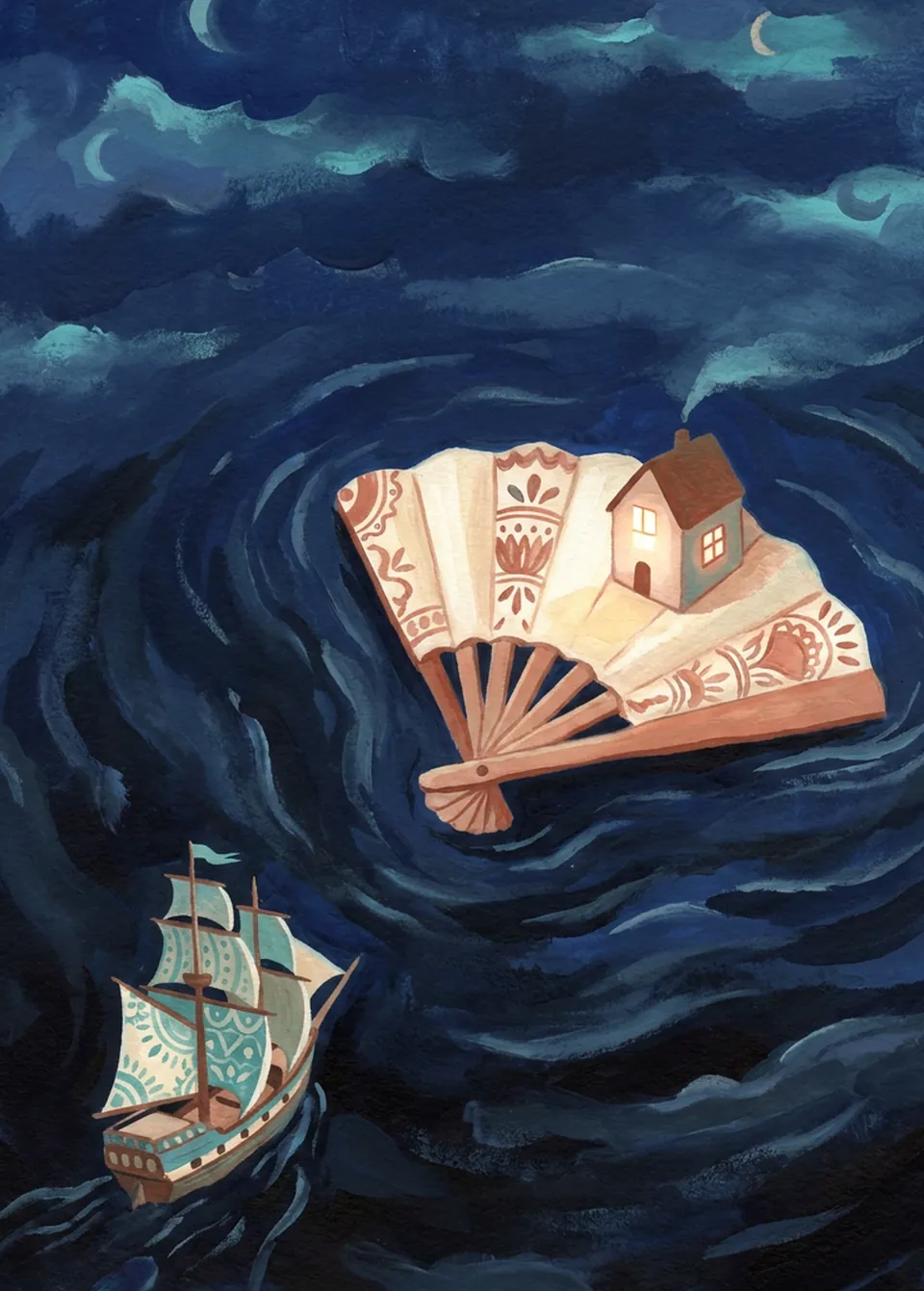
A closed country watching the world through a single opening.
Why this image
On a dark, swirling night sea an open fan floats like a small island, with one little house on it and a single lit window; a sailing ship with patterned sails comes towards it. From 1641 to 1854 the Dutch trading post on Deshima, an artificial island in the bay of Nagasaki, was the only Western one allowed to trade, and so Japan's window on the outside world 1. Through it went more than ten thousand Western books, and out of them grew rangaku, 'Dutch learning' 2. Not painted, but the window opened the other way too: in 1863 two Japanese students came to Leiden to study under Professor Simon Vissering, who encouraged them to join La Vertu 3.
What it draws on · 3
Deshima
From 1641 to 1854 the Dutch held a trading post on Deshima, an artificial island in the bay of Nagasaki. For two centuries they were the only Western nation permitted to trade with Japan, and so Japan's window on the outside world. Chinese silk, cotton, sugar, medicines, deer hides, books and scientific instruments went in; copper, silver, camphor, porcelain, lacquerware and rice came back.
Sources · 2
- Wereldmuseum Leiden — 'Deshima, the Dutch trading post in Nagasaki'
- National Diet Library Japan — 'Japan-Netherlands Exchange in the Edo Period: Dutch Factory on Deshima'
rangaku
The trade also brought knowledge. Between the end of the eighteenth century and the beginning of the nineteenth, VOC staff sold more than ten thousand Western books to Japanese buyers, and out of them grew rangaku, 'Dutch learning': language, medicine and natural science, read in Dutch. Over that period the Dutch changed, in Japanese eyes, from commercial agents into importers of European knowledge.
Sources · 2
- National Diet Library Japan — 'Japan-Netherlands Exchange in the Edo Period'
- Wacana — 'Dejima; VOC dan rangaku' (Bambang Wibawarta)
Simon Vissering
In 1863 Nishi Amane and Tsuda Mamichi came to Leiden, sent by the shogunate to study political science, constitutional law and economics. Their teacher was Professor Simon Vissering, himself a freemason and a member of La Vertu. He encouraged his two Japanese students to join.
Sources · 3
- Loge La Vertu — 'Leiden, Japan en de vrijmetselarij'
- Cambridge — 'Freemasonry in Japan', in Britain & Japan Biographical Portraits vol. IX
- Jan Rezelman, 'In de voetsporen van Nishi en Tsuda. Twee Japanners en Loge La Vertu 1863-1865' (2024)
Shares its places with · 6
 Carried HomeJapan Museum SieboldHuis · Loge La Vertu
 The Same RouteJapan Museum SieboldHuis
 Only the YieldJapan Museum SieboldHuis
 The SilenceLoge La Vertu
 Remain What You AreLoge La Vertu
 Under One RoofLoge La Vertu
Painted with an image model from the facts on this page, and chosen by hand. City in Motion.