Two Nights
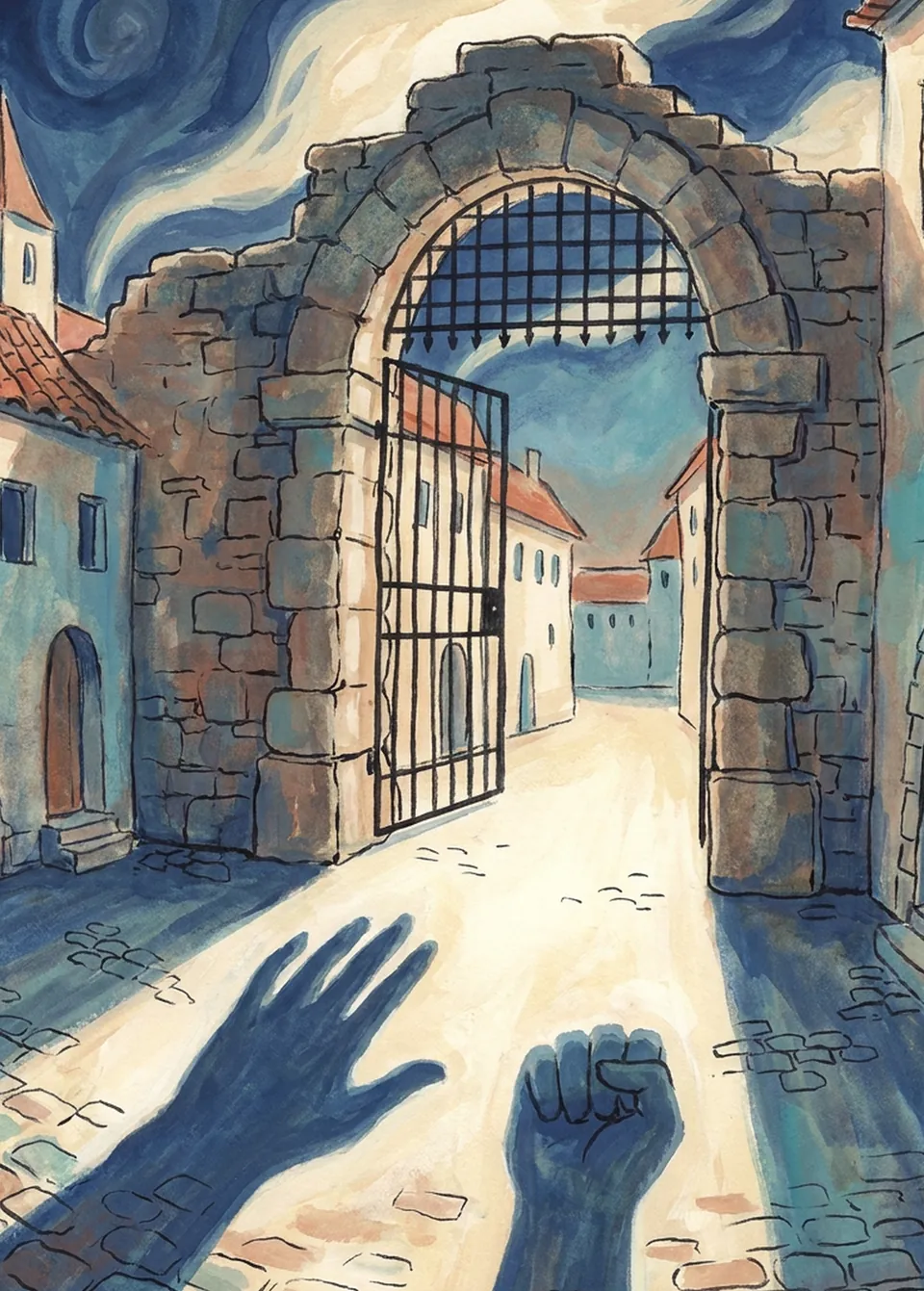
A stranger may stay two nights; then the gate decides.
Why this image
A heavy stone gate stands at dusk, its iron gate half open on the street beyond; on the cobbles lie two long shadows, an open hand and a closed fist. At the Morspoort visitors were registered and given a pass, strangers with no clear business could stay at most two nights, and in the evening the gate closed 1. Those not allowed in stayed outside; those who had come too far in were locked up in its dome 2. The duty on goods was charged at the gate, as at the scales of the Waag 3. Not painted, but the same open hand today: De Bakkerij keeps four rooms for emergency stays and helps asylum seekers and undocumented people 4.
What it draws on · 4
wie er binnen mocht
The gate also stopped people. Visitors had to be registered there and were given a pass; that was how the city tried to keep travelling beggars out. Strangers with no clear business in town could stay at most two nights. In the evening the gate closed — half past ten in summer, half past eight in winter — and opened again only in the morning.
Sources · 3
- Leiden In Motion: De Diversity Walk — Stichting Güney / Turksarchief.nl
- Nederlandstalige Wikipedia — Poort (doorgang): inschrijving, pas, bedelaars, sluitingstijden
- Stadsherstel Amsterdam — Muiderpoort: functie van de stadspoort
de gevangenis in de koepel
The Morspoort was a multi-purpose building. Cells were built into the octagonal dome, and the gate served for a long time as a prison. Those not allowed in stayed outside; those who had come too far in were locked up inside it.
Sources · 2
- Nederlandstalige Wikipedia — Morspoort: cellen in de achtkantige koepel, dienst als gevangenis
- Erfgoed Leiden en Omstreken — 'Vondst van de week: tongewelven in Morspoort'
wegen en accijns
The goods of merchants from other cities were weighed and checked here as well. In this way Leiden could guard the quality of the products and levy excise on them. At the city gate the duty was charged on entry, at the Aalmarkt on the scales: the city measured who came in and what he was carrying.
Sources · 2
- Rijksmonumenten.nl / Erfgoed Leiden — Waag en Boterhal: goederen van kooplieden uit andere steden gewogen en gecontroleerd, accijnsheffing
- Nederlandstalige Wikipedia — Poort (doorgang): accijnsheffing door poortwachters
asielzoekers en ongedocumenteerden
De Bakkerij runs Makaazi Ya Imani, a shelter with four rooms for emergency stays, and together with Leiden's churches takes in asylum seekers from Ter Apel. Help also reaches undocumented people and labour migrants who fall through every provision there is; the Comité Ondersteuning Ongedocumenteerden Leiden — the city's committee for the support of the undocumented — works out of this building.
Sources · 3
- Leiden In Motion: De Diversity Walk — Stichting Güney / Turksarchief.nl
- Diaconaal Centrum De Bakkerij — debakkerijleiden.nl/ons-werk/projecten
- Comité Ondersteuning Ongedocumenteerden Leiden (COOL)
Shares its places with · 8
 The ScaleMorspoort · Waag Building
 The Ring Still ClosingMorspoort
 Higher GroundDiaconal Center De Bakkerij
 From Care to RightsDiaconal Center De Bakkerij
 Under One RoofDiaconal Center De Bakkerij
 Bread for a TokenDiaconal Center De Bakkerij
 The Lion Steps DownWaag Building
 Where Waters MeetWaag Building
Painted with an image model from the facts on this page, and chosen by hand. City in Motion.